Financial institutions quarterly M&A updates
Executive summary: Q3 2026 financial institutions M&A update
This executive summary highlights key developments from the Q3 2026 financial institutions M&A update by Wipfli Corporate Finance Advisors, LLC. It focuses on U.S. deal activity, valuation trends and industry dynamics.
Market drivers and industry conditions
Succession planning remains the primary catalyst for community bank transactions, as aging leadership teams and shareholder bases continue to evaluate strategic alternatives amid limited next-generation leadership pipelines.
At the same time, community banks face mounting pressure from rising technology costs, cybersecurity concerns, fraud risks and the need for continued investment in digital banking, artificial intelligence and data capabilities. These challenges are driving institutions to seek greater scale, operating efficiencies and long-term sustainability through consolidation.
Improved regulatory visibility has also helped support transaction activity across the sector.
Deal activity and valuation trends
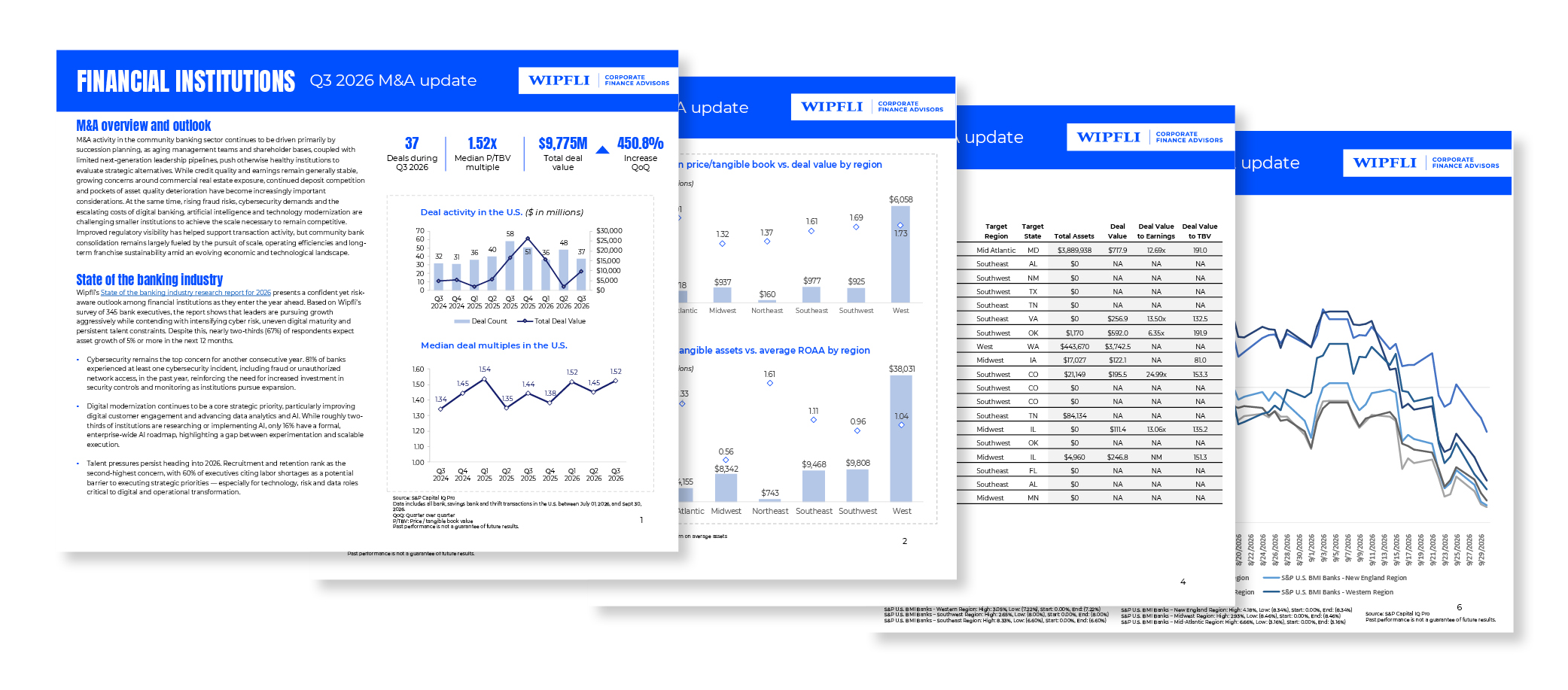
37 U.S. bank transactions were announced in Q3, and total deal value reached approximately $9,775 million. While deal count declined from the previous quarter, total deal value increased significantly, driven by several larger transactions announced during the period.
Median pricing remained stable, with transactions completed at a median price-to-tangible book value multiple of 1.52x, underscoring continued buyer interest in well-positioned financial institutions with attractive market presence, sound financial performance and growth potential.
Regional dynamics
Regional activity varied considerably in Q3. The Southeast led all regions in announced transaction volume with 11 deals, followed closely by the Southwest and Midwest. However, the West accounted for the largest share of total deal value, generating more than $6 million in announced transactions.
Banking index performance
Public bank equities experienced broad weakness during the quarter. All six regional banking indices finished lower, reflecting concerns around economic uncertainty, deposit competition, commercial real estate exposure and asset quality trends.
The Mid-Atlantic region demonstrated the strongest relative performance, while banks in the Midwest and New England experienced the largest declines. This performance highlights ongoing investor caution as financial institutions balance growth ambitions with evolving risk, regulatory and technology demands.